
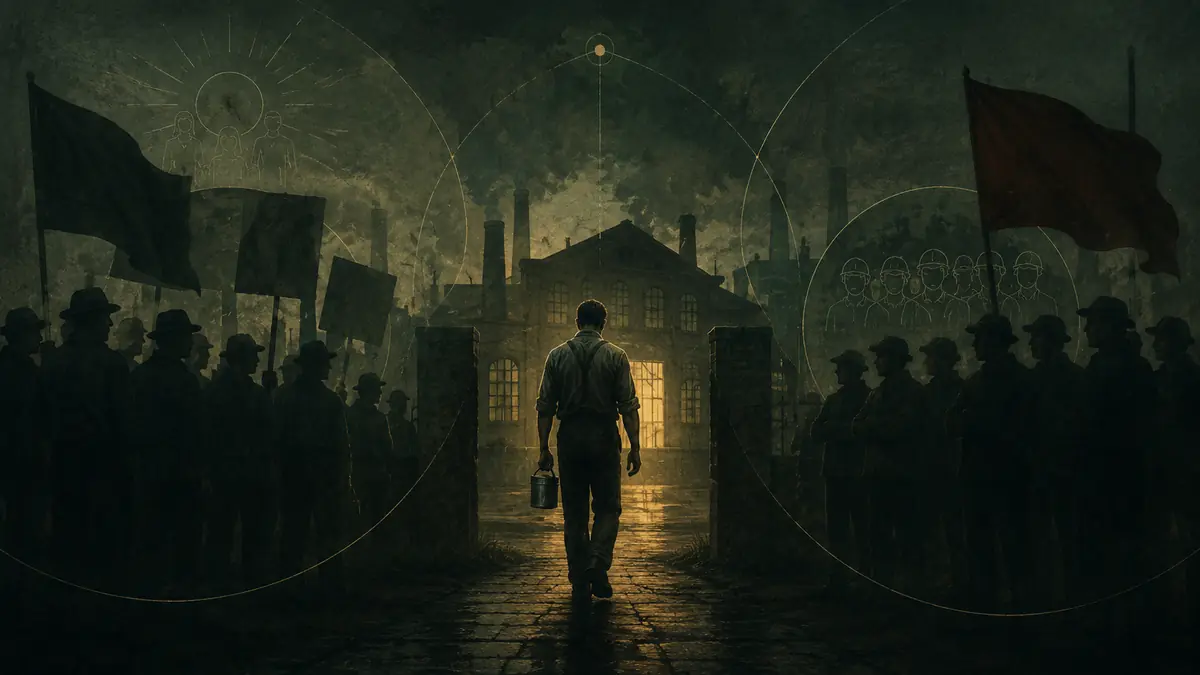
Strikebreakers—often referred to as “scabs”—are workers who continue to work during a strike.They may be hired from outside the company or may be employees who refuse to participate in the strike. The term “scab” originally described a “lowlife” in 16th-century Britain but gained popularity in labour movements after an 1881 strike by Pittsburgh messenger boys. Labour unions regard strikebreakers as a direct threat to their ability to bargain effectively. The power of a strike comes from its ability to halt production and pressure employers into negotiations. When employers bring in strikebreakers, they reduce the strike’s impact, divide the workforce, and ultimately weaken union power.This is especially contentious when the strikebreakers are fellow union members, which many see as a betrayal of collective solidarity. Such tensions have historically led to conflicts, including harassment, threats, and even violence. From the union perspective, refusing to strike undermines the shared struggle for better conditions and constitutes a form of class disloyalty.
However, those who choose to work as strikebreakers often do so out of necessity. Companies may offer higher temporary wages to attract replacement workers, making the role financially tempting—especially for those facing economic hardship. For some, it may be a matter of putting food on the table rather than taking a stand. Still, the risks are high. Strikebreakers are often undertrained, face social ostracism, and may be exposed to unsafe conditions or resentment from their peers. Their short-term gain can come at the cost of long-term damage to workplace unity and trust.
Employers argue that hiring strikebreakers is a legitimate way to protect their business and ensure continuity. Rather than giving in to union demands or risking financial collapse, employers see this strategy as a means of surviving during disputes. Keeping operations going can help preserve relationships with clients, prevent losses, and sustain investor confidence. In countries like the United States, employers are legally permitted to hire strikebreakers—even permanently—during labour disputes. In contrast, countries such as Germany and France heavily restrict or ban the practice, recognising the potential for abuse and union busting. The United Kingdom, once aligned with this approach, has recently lifted its ban on strikebreakers under certain circumstances, sparking renewed debate.
The morality of strikebreaking remains sharply contested. Unions see it as an act that undermines worker power and collective bargaining. Employers defend it as a necessary option in times of industrial conflict. And individuals who take strikebreaking roles often face the difficult tension between supporting their fellow workers and meeting their own urgent needs. The debate raises complex questions about loyalty, survival, and the limits of solidarity.
1.Is it morally permissible to work as a strikebreaker? Why or why not?
2.Would an employer be justified in using strikebreakers if failing to do so could result in the collapse of the business?
3.Should personal needs and interests ever outweigh the collective interest of workers in a strike?
4.Can strikebreaking ever be an act of courage or moral choice, or is it always a betrayal of solidarity?
Main Stance
POV: It is morally permissible to work as a strikebreaker. From a libertarian perspective, individuals possess absolute self-ownership and the freedom of contract, meaning working is a voluntary exchange that does not violate the negative rights of others.1 Furthermore, from a deontological perspective, forcing an individual to sacrifice their livelihood for the sake of a collective labor movement treats them as a mere tool, which is a fundamental violation of their moral personhood.
When examining the morality of strikebreaking, two distinct philosophical paths assist in the analysis. From the libertarian path, we recognize that striking workers absolutely possess the right to withhold their own labor to demand better conditions; however, they do not hold a proprietary claim over the jobs themselves. Because the strikebreaker does not actively steal from, physically harm, or infringe upon the property rights of the striking workers, their action of accepting a job cannot be deemed inherently immoral.
From the deontological path, we must look at Kantian ethics, specifically the principle that human beings are ends in themselves and must never be used merely as a means to an end. Strikebreakers often take these roles out of desperate economic necessity—to put food on the table. To demand that a vulnerable worker remain unemployed and suffer financial ruin so that the broader union can achieve a successful collective reform is to use that individual merely as an instrument for the collective's benefit. This objectifies the worker, stripping them of their autonomy and disrespecting their moral personhood.
We might consider a major objection:
The Utilitarian / Solidarity Objection: Working as a strikebreaker is morally impermissible because it undermines collective bargaining, delays necessary labor reforms, and consequently causes a long-term decrease in the overall welfare of the working class.2
The key move of this objection is to shift the focus from individual rights to collective consequences. It argues that by reducing the impact of the strike, the strikebreaker allows employers to maintain poor conditions, leading to greater systemic suffering.
Although we may acknowledge that strikes can lead to positive reforms for workers, this utilitarian calculus fundamentally fails to respect the autonomy of the individual. To illustrate this response, we may consider an analogy.
Analogy to Forced Protest: Imagine a group of activists blocking a vital road to protest an unjust government policy. A pedestrian, who urgently needs to get to work to pay for their child's medical care, tries to cross the blockade. The activists stop them, arguing that if the pedestrian goes to work, it weakens the optical power of the protest and delays a reform that will benefit thousands. We tend to think there is nothing morally wrong with the pedestrian insisting on crossing. Even if the protest's goal is noble and consequentially beneficial, the activists have no moral right to forcibly draft the pedestrian into their cause or demand they sacrifice their child's welfare for the collective movement.
The core reason this objection fails is that moral obligations generally require consent. In our daily lives, we are not ethically bound to sacrifice our fundamental survival for a revolution we did not agree to join. As established in deontological ethics, a person’s survival cannot be forcibly subordinated to the mathematical welfare of the majority. Therefore, even if a strike might eventually increase overall welfare, it is impermissible to force the individual strikebreaker to bear the immediate, devastating cost of that revolution.
Q1. Is it morally permissible to work as a strikebreaker? Why or why not?
POV: Yes, it is morally permissible. Arguments and objections have been discussed in the Main Stance.
To reiterate, under a libertarian framework, it is a voluntary contract that does not violate the property or negative rights of striking workers. Under deontology, preventing someone from working to support themselves in order to fuel a collective labor movement is unethically treating that human being as a mere tool for societal reform.
Q2. Would an employer be justified in using strikebreakers if failing to do so could result in the collapse of the business?
POV: Yes, an employer is highly justified in using strikebreakers, as it is a legitimate exercise of their own freedom of contract and self-preservation.
Just as workers have the right to withhold their labor to protect themselves from conditions they deem unacceptable, the employer has the right to contract willing workers to protect their business from complete financial ruin. So long as the employer is not engaging in coercion or fraud, hiring replacement workers is a peaceful, voluntary market transaction. Denying an employer the right to save their livelihood would essentially grant unions a coercive monopoly over the business's existence.
Q3. Should personal needs and interests ever outweigh the collective interest of workers in a strike?
POV: Yes, personal needs—especially those regarding basic survival and autonomy—must inherently outweigh forced collective interests.
As argued in the Main Stance through Kantian deontology, prioritizing the collective interest over an individual's urgent personal needs effectively objectifies the individual. While voluntary solidarity is admirable, a worker's primary moral duty is often to their own survival and their family's well-being. The collective interest of a union cannot morally override a human being's fundamental right to sustain their own life through honest labor.
Q4. Can strikebreaking ever be an act of courage or moral choice, or is it always a betrayal of solidarity?
POV: It can absolutely be an act of courage and a valid moral choice; it is only considered a "betrayal" if one assumes the worker owed allegiance to the collective in the first place.
Strikebreakers often face immense social ostracism, harassment, threats, and even physical violence from union members. Choosing to walk through a hostile picket line to ensure one's family does not go hungry requires immense personal courage. It is a moral choice to prioritize one’s direct dependents over the abstract demands of a labor union. Because the worker may never have consented to the union's collective struggle, their actions constitute self-preservation, not betrayal.3
Endnotes
- See Nozick, Robert. Anarchy, State, and Utopia. Basic Books, 1974. back
- Compare the stronger defense of a right to strike in Gourevitch, Alex. “The Right to Strike: A Radical View.” American Political Science Review, vol. 112, no. 4, 2018, doi:10.1017/S0003055418000321. back
- ChatGPT is listed as an author because it contributed substantive writing and/or polishing to this published work. This credit does not mean that ChatGPT originated the topic or ideas; the core argument and the final editorial responsibility remain with the human author. back