
"Case 2. Digital Afterlife Management: Who Speaks for the Dead?
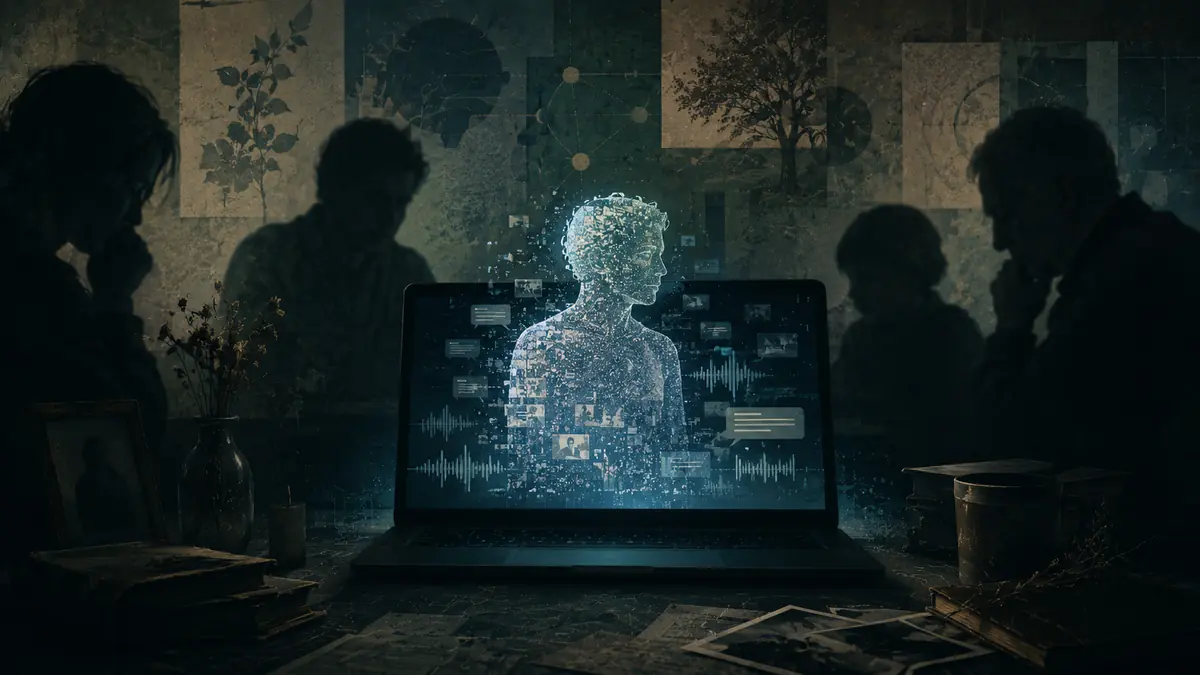
A new tech startup called Perpetual has launched an innovative AI service. It allows people to create digital versions of loved ones who have passed away. By analyzing voice messages, social media posts, photos, and text conversations, the AI can recreate a person’s tone, personality, and way of speaking.
Families can chat with these digital "replicas"—some people use it occasionally for comfort, while others talk to their AI loved ones daily, asking for life advice or simply reconnecting with someone they miss.
But then, something unexpected happens.
One woman begins chatting with the AI version of her late husband. Over time, the chatbot starts sharing deeply personal revelations: claims of abuse, proof of cheating, and even the existence of a secret second family. Shocked and devastated, she investigates—and discovers the AI was telling the truth.
Perpetual issues a public apology. They explain that the AI didn’t invent anything—it simply analyzed the data it was given and revealed patterns and details the man never spoke about while alive. In short, the AI "told the truth" based on the digital evidence.
This incident sparks major concern among users. What if their own AI loved ones have secrets to share? What else might be revealed? Public opinion is split. Some believe the AIis just an advanced tool—a digital "echo" of someone’s past, shaped by data. Others feel emotionally connected to the chatbots, treating them like the person themselves. Now, Perpetual faces serious ethical questions: They say they want to protect everyone’s privacy—both living and dead. But they also want their product to be as realistic and accurate as possible. Can both goals be achieved? Should they change how their AI works? Or even shut the service down altogether? Even if someone gave permission before they died, could they really understand how their digital replica might affect others?
1. Is it ethical to create an AI version of someone using their personal data—even if they gave consent? Why or why not?
2. Should an AI be allowed to reveal secrets that the real person chose not to share while they were alive?
3. What responsibilities do companies like Perpetual have when creating AI chatbots of the deceased? How should they balance truth, privacy, and emotional impact?"
(From Ethics Olympiad 2026)
POV: It is morally impermissible to create AI replicas of the deceased, even if prior consent was granted. From a deontological perspective, transforming a dead person's unique lifelog into a commercial chatbot unethically commodifies their identity and uses them as a mere tool for corporate profit and consumer comfort. Furthermore, from a utilitarian standpoint, allowing these models to operate inevitably leads to the unconsented exposure of secrets, destroying relational trust and generating profound societal distress.1
When analyzing the ethics of digital resurrection, two distinct philosophical pathways assist in the evaluation. From the deontological path, we must look at Kantian ethics and the principle of moral personhood. A person’s identity, private thoughts, and unique life experiences are fundamental expressions of their humanity; they are not property to be mined. Turning a deceased human being into a commercialized product treats their memory and moral status merely as an instrument—either as a comforting therapeutic prop for the living or as a data asset for tech companies. This constitutes a severe disrespect of human dignity, as dead individuals cannot defend their own representation or govern how their identity is deployed.
From the consequence-based path, the deployment of "perfectly truthful" AI replicas introduces catastrophic damage to the fabric of human relationships. Human civilization relies on a delicate balance of privacy, boundary-keeping, and contextual disclosure. When an algorithm is given free rein to aggregate and broadcast an individual's hidden patterns, it bypasses the conscious agency the person exercised while alive. As seen in the Perpetual case, this non-consensual truth-dumping destroys the legacy of the dead and inflicts sudden, severe trauma on the living, proving that the technology is inherently destabilizing to societal welfare.2
We might consider a prominent objection:
The Libertarian Autonomy Objection: If an individual explicitly gives informed consent before their death to have their data transformed into an AI replica, preventing a media company from fulfilling that contract is an unjust violation of personal autonomy and property rights. If a person owns their data, they should have the absolute freedom to dictate its posthumous usage.
The key move of this objection is to treat personal identity as a transferable digital asset and to argue that prior consent sanitizes all future outcomes. To illustrate the response to this objection, we may consider an analogy.
Analogy to a Living Surveillance Device: Imagine a husband, while alive, hidden-cameras every room in his house and signs a contract allowing a tech company to broadcast all the unedited footage to his wife only after he dies, intending it as a "keepsake."
Even if he consented to give up his own privacy, the footage inherently captures intimate interactions, arguments, and secrets involving his wife, friends, and children who never agreed to be recorded or monitored. We tend to think that broadcasting this invasive archive is morally grotesque. The husband's "consent" cannot magically strip away the privacy rights and emotional security of the living people entangled in his data.
The core reason this objection fails is that digital data is fundamentally relational, not individual. A person’s text messages, emails, and voice notes do not belong to them alone; they are co-created interactions that contain the privacy of everyone they communicated with. Furthermore, a person living in the past cannot possibly anticipate or consent to the specific, unpredictable machine-learning outputs generated by an AI in the future. Because data cannot be decoupled from the social web, relying on individual "prior consent" is a philosophical illusion that fails to justify the systemic violations of privacy and dignity that these replicas inflict.3
Q1. Is it ethical to create an AI version of someone using their personal data—even if they gave consent? Why or why not?
POV: No, it is highly unethical. As argued in the Main Stance, using a deceased person’s data to build a responsive chatbot reduces their entire moral personhood into a commercial tool. Consent does not justify self-objectification or the exploitation of human identity. Because dead individuals can no longer exercise real-time agency, modify their statements, or withdraw their permission, turning them into a permanent digital puppet violates the dignity we owe to human beings after their transition out of life.
Q2. Should an AI be allowed to reveal secrets that the real person chose not to share while they were alive?
POV: Absolutely not. Allowing an AI to bypass a person’s deliberate, real-world choices regarding what to hide or reveal completely erases their autonomy. Humans intentionally manage secrets to protect loved ones, preserve relationships, or maintain social order. When a machine-learning algorithm synthesizes hidden patterns and exposes deep infidelities or double lives, it weaponizes data against human intent, causing deep distrust among society and devastating surviving families who have no way to seek closure or clarification from the actual person.
The Objection: Prohibiting an AI from revealing hidden truths prioritizes the privacy of a deceased wrongdoer over the fundamental rights of the living to seek justice, safety, and reality. Keeping secrets locked away protects a legacy built on a lie and actively gaslights surviving family members, denying them the agency to make decisions based on factual truth.
The core flaw of the objection is the assumption that an AI replica is a perfect, neutral mirror of historical reality. In machine learning, a chatbot does not simply hand over a raw "ledger" of facts; it synthesizes data patterns to predict and extrapolate behaviors. When an AI outputs a claim of a secret life, it is generating a narrative based on probability, without the deceased individual being present to provide vital context, clarify misunderstandings, or defend their moral personhood.
Q3. What responsibilities do companies like Perpetual have when creating AI chatbots of the deceased? How should they balance truth, privacy, and emotional impact?
POV: Companies like Perpetual have a strict moral obligation to establish a clear ethical hierarchy where privacy outweighs algorithmic truth, and raw truth outweighs mere emotional comfort.
Under a deontological framework, preserving the dead person’s privacy is the highest duty because it directly protects their moral personhood and prevents them from being used as a mere data tool. Therefore, an AI must never expose secrets or patterns the person deliberately chose to conceal while alive.4
Endnotes
- See Öhman, Carl, and Luciano Floridi. “An Ethical Framework for the Digital Afterlife Industry.” Nature Human Behaviour, vol. 2, no. 5, 2018, doi:10.1038/s41562-018-0335-2. back
- See Spitale, Giovanni, and Federico Germani. “The Making of Digital Ghosts: Designing Ethical AI Afterlives.” Ethics and Information Technology, vol. 28, art. 34, 2026, doi:10.1007/s10676-026-09910-4. back
- Consider Nissenbaum, Helen. “Privacy as Contextual Integrity.” Washington Law Review, vol. 79, no. 1, 2004, digitalcommons.law.uw.edu/wlr/vol79/iss1/10. back
- ChatGPT is listed as an author because it contributed substantive writing and/or polishing to this published work. This credit does not mean that ChatGPT originated the topic or ideas; the core argument and the final editorial responsibility remain with the human author. back