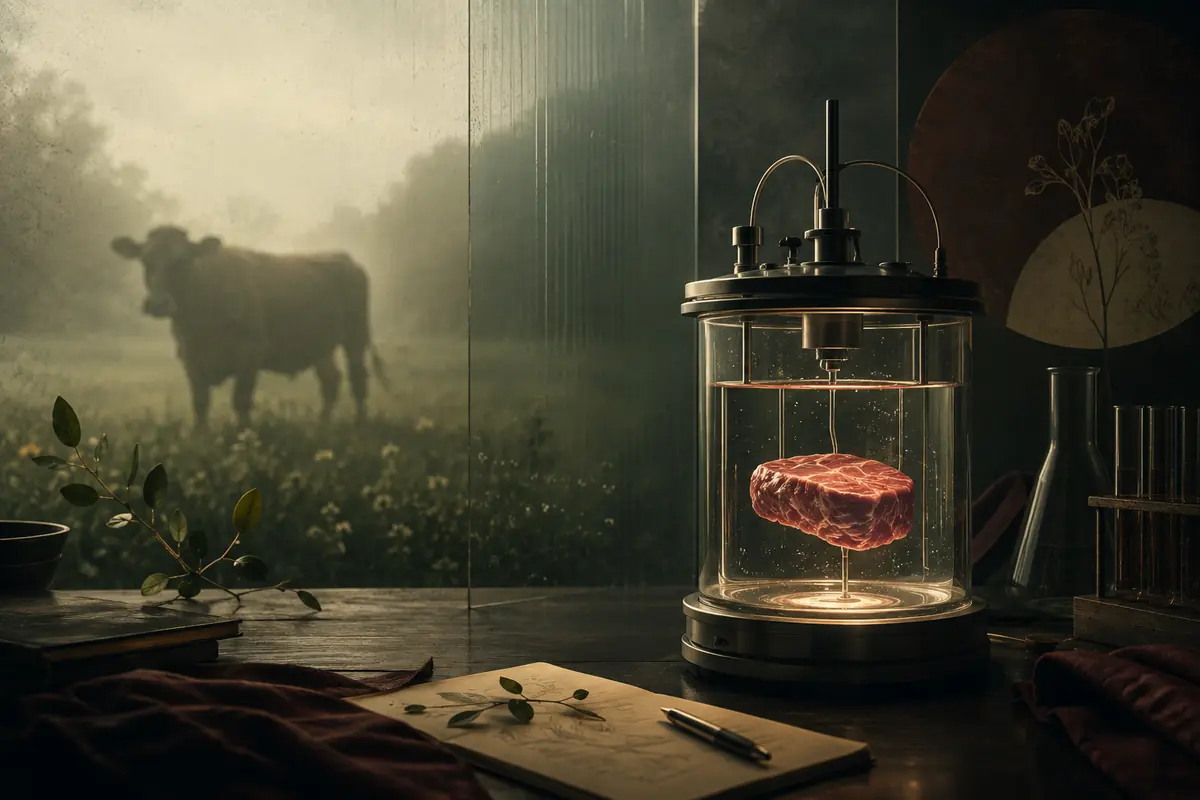
"Case 3. In-Vitro Meat
So-called ‘in-vitro’ meat, cultivated from the cells of animals and grown in laboratory vats, has been approved for human consumption in certain countries.4 It has been predicted to become a sustainable and environmentally beneficial alternative source of protein for future generations. Since traditional animal raising practices are an inefficient use of land and modern factory farming is environmentally damaging, in-vitro meat would provide an efficient and environmentally better option for meat-eaters. In addition, it does not involve inflicting suffering on and then killing animals. Consequently, it may also be a particularly tempting option for ethical vegetarians and vegans who hold that consuming (at least the vast majority of) animal products is morally wrong. Since helping to provide nutrition for the world’s population is plausibly a duty we all share, finding a sustainable source of protein is paramount. Thus, many are keen to promote meat alternatives such as in-vitro meat as the solution to both environmental and humanitarian problems. Furthermore, it may provide an alternative source of nutrients to some popular plant-based diet staples which are ethically problematic, such as avocados5 and soy-based 6 meat substitutes.
Given that many people are averse to unfamiliar foods and reluctant to adopt new things, it may be questioned how widespread uptake of in-vitro meat is likely to be. Initially, it is unlikely to be produced in large quantities and so will be very expensive. Even when produced at scale, it is estimated that cultivated meat could cost between $21-$67 AUD ($13-$67 USD) per kg to produce, making the cost to the consumer potentially as high as $195-$156 AUD per kg ($67-$100 USD). This means that it is initially only likely to be a realistic option for wealthier people and may never become an option for the majority of the world. Thus, some would argue that we should eat a non-processed plant- based diet, since this is less environmentally damaging and could feed the world’s current population in a sustainable way.
1. Is it permissible for wealthier people to buy certain expensive meat alternatives, such as in-vitro meat, even if they are unaffordable to the majority?
2. Which type of consideration is most important in determining the morally best diet: impact on the environment, treatment of animals, or care for humans?
3. If the current omnivore diet is ethically unsupportable, should we support the development of in-vitro meat on the grounds that not everyone is going to adopt a vegan or vegetarian diet?"
POV: In-vitro meat is ethically better than an omnivore diet, although an omnivore diet is not impermissible in the way that human murder is (it is suberogatory, or in Elizabeth Harman’s terms, it is a morally permissible moral mistake).
The classic, mainstream argument for vegetarianism grounds on the Sentience Line, the idea that moral status depends on whether a being is sentient and whether it can suffer. By this arguments, “all animals are born equal”, and thus we should not eat meat, since this produces suffering. However, the Sentience Line fails to explain many interesting cases:
Analogy to the tribal hunter in Alaska: surely the vegetarian project cannot suggest a tribal hunter in Alaska whose tribes have been living on meat for countless generations to only survive on plants, especially since vegetarian diets may be inaccessible, costly, or nutritionally insufficient for him (he may not have vitamin supplements). Normally vegetarians indeed do not believe that it is wrong for him to eat meat. Indeed, utilitarian vegetarian activists like Bentham’s Bulldog do stress that they had never insisted that tribal hunters go eat plants, and that battling factory farming and persuading citizens in wealthy countries to opt for vegetarian diets had always been instead a major focus.1
Or consider this case:
Analogy to every-day accommodations: many vegetarians, while suggesting that we should eat meat, very occasionally eat meat. Sometimes, they may choose vegetarian diets at restaurants that also serve meat. If it is completely impermissible to eat meat, impermissible to the extent that murder is, then surely the said actions would seem wrong however occasional. However, these accommodations do occur.2
The above cases may be better explained if we understand sentience not as a line but as a spectrum, similar to how Shelly Kagan and Jeff McMahan argued. Human interests may weigh more against animal interests because we are more complex in terms of sentience and capabilities to suffer (but intelligence is irrelevant).
However, both the Sentience Line and the Sentience Spectrum seems somewhat arbitrary. Why is it that oysters and fishes are not sentient, or that one type of fish is less sentient than another? Measures of sentience (or degrees of sentience) may not be as easy as they seem, and using sentience to draw lines or spectrums may even sometimes seem both biologically and morally arbitrary. Thus, an even better approach is to turn away from sentience, which belongs to properties-based ethics, and instead turn to relation-based ethics. We may understand moral status and moral values as the product of reciprocal relationships3 instead of properties (like sentience); this explains the accommodations while justifying vegetarianism. Relations to humans, compared against relations with husbandry animals and with wild insects, renders it such that we have more moral obligations to our fellow humans than to husbandry than to wild insects, generally speaking. However, humans and animals still have obligations relative to each other, as we have relationships whether at the more micro-level (e.g. pet-human relation) or at the more macro-level (e.g. animals in husbandry). Thus, animals do have moral status; it is simply that killing an animal for meat may not always be impermissible, since arguably humans have more obligations to each other than to animals, rendering the moral status of animals weighs less than the moral status of humans. This makes it possible for omnivore diets to be defeasibly permissible albeit morally problematic, especially in countries where vegetarian diets may be difficult to access, costly, nutritiously inadequate, or even impossible for survival. Relation-based ethics accounts for the highly intuitive and explainable conclusions presented by the Sentience Spectrum while avoiding the difficulties of property-based ethics.
Note that the above does not attack vegetarianism; it only attacks the thesis that eating meat is absolutely impermissible to the extent that murder is and that animals' interests are morally equivalent to humans'. I argue that eating meat is suberogatory, or in Elizabeth Harman’s terms, “a morally permissible moral mistake”, and while it is better to be vegetarian, eating meat is by no means murder.
Q1. Is it permissible for wealthier people to buy certain expensive meat alternatives, such as in-vitro meat, even if they are unaffordable to the majority?
POV: Yes. When the option is practically possible, vegetarian diets are always morally better.
From both the Sentience Line, the Sentience Spectrum, and the Relational Turn, we can see how vegetarian diets, whether morally required or not, is morally better than omnivore diets. In-vitro meat is ethically vegetarian, as we do not understand lab-grown meat to be animals. In-vitro meat does not come from beings that are involved in reciprocal relationships, at least not in relationships like those between humans and pets, humans and animals, or humans and fellow humans, and thus certainly does not have, relative to humans, any moral status. Since animals would have reciprocal relationships, either with individual humans or with human civilization as a collective, it would be far less moral to eat animals than to eat in-vitro meat. In fact, opting for vegetarian diets should begin with the wealthiest, as they are often those who can absorb the costs of switching to vegetarian or in-vitro diets.
Q2. Which type of consideration is most important in determining the morally best diet: impact on the environment, treatment of animals, or care for humans?
POV: Care for humans. Due to the nature of the respective relationships, the moral status of humans, arising relative to other humans via the existence of reciprocal relationships, are greater than the moral status of animals, arising relative to humans via the existence of reciprocal relationships. Or at least, in weaker terms, we have more obligations to fellow humans than to farm animals because we have stronger reciprocal relations with humans in our societies than with most farm animals (with some exceptions being shepherd dogs and household pets, which we may have more obligations to compared to an absolute stranger).
Q3. If the current omnivore diet is ethically unsupportable, should we support the development of in-vitro meat on the grounds that not everyone is going to adopt a vegan or vegetarian diet?
POV: Yes. As in Q1, in-vitro meat is not ethically problematic even if compared against vegetarian diets, because in-vitro meat does not come from beings who are in reciprocal relations with humans – at least, that relation is by no means comparable to human-human, human-pet, or human-animal relations.4
Endnotes
- Matthew Adelstein, utilitarian, vegetarian, and EA activist, (pseudonym “Bentham’s Bulldog”), writes that “when people in the west tell others to go vegan, they are not talking to indigenous seal hunters, obviously. They’re talking to other westerners. In wealthy countries, almost everyone could go vegan if they so chose. Whether it’s okay for indigenous seal hunters to hunt seals is wholly beside the essential point”. https://benthams.substack.com/p/why-i-find-woke-criticism-of-veganism back
- Elizabeth Harman’s paper “Eating Meat As A Morally Permissible Moral Mistake” https://static1.squarespace.com/static/5ebc5c2582dd0f3baac5e9cc/t/623b4a9ed371ee58be1c4039/1648052895046/Eating+Meat+as+a+Morally+Permissible+Moral+Mistake+2nd+Set+of+Proofs.pdf back
- I say reciprocal relationships because it is not only how the human treats the animal matters. Reciprocal relationships avoid anthropocentrism, because it is the relation between and status of both ends of the relationship (relative to each other) that matters. back
- ChatGPT made minor edits to this article. back